Water Features for Newcastle Gardens: What Works and What's Worth the Cost
Water features have a tendency to look better on Pinterest than they perform in a north-east garden over the course of a couple of years. The ones that end up being switched off, unplugged, or quietly removed are the ones that were chosen for appearance alone without thinking through how they'll work in Newcastle's climate, what maintenance looks like through autumn and winter, and whether the installation was done properly in the first place. That's not an argument against water features - it's an argument for choosing the right one and having it installed correctly.
What Works Well in a Newcastle Garden
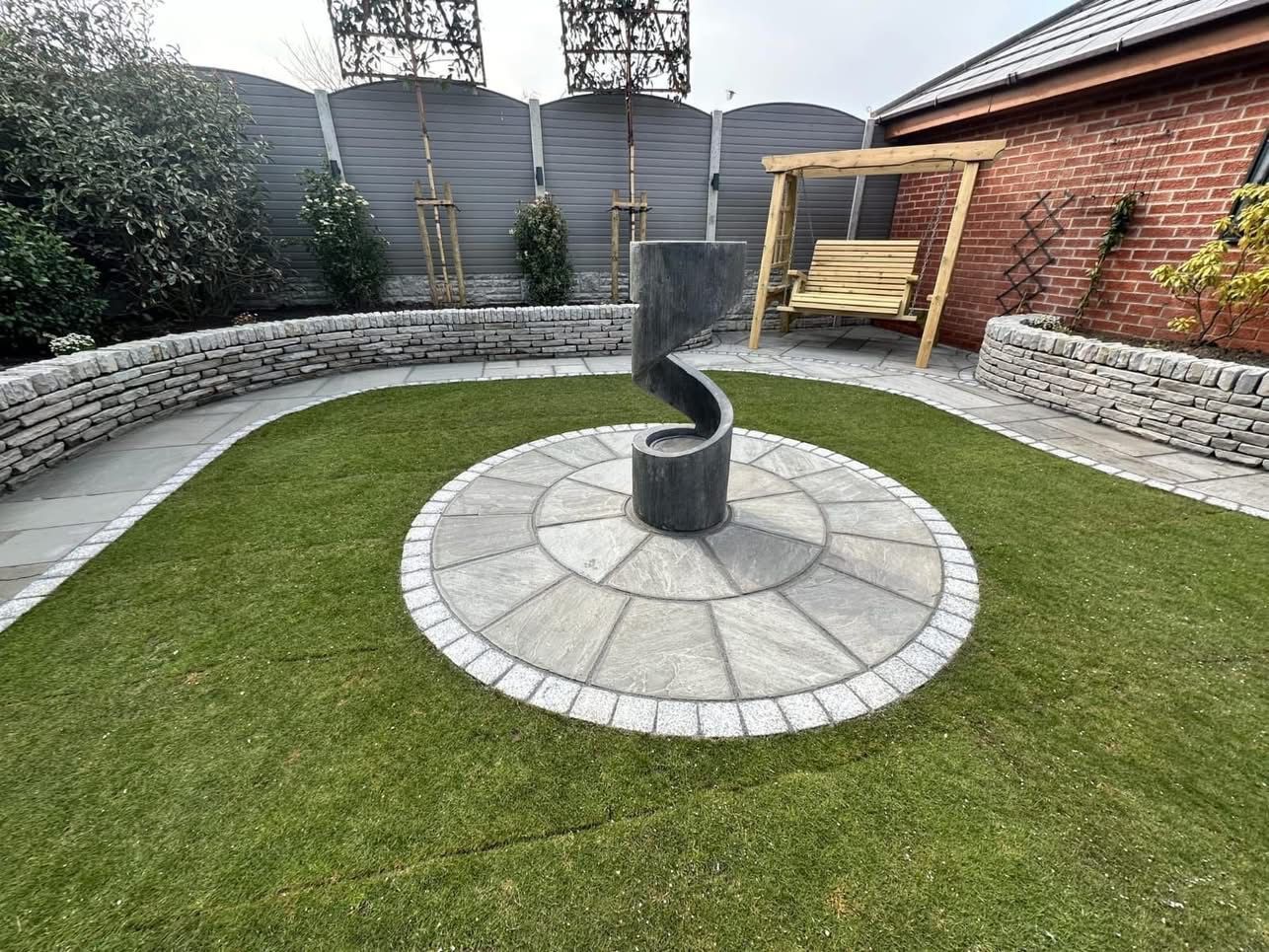
Self-contained water features with a reservoir. The most practical type for most Newcastle residential gardens - the water circulates through a pump from a hidden reservoir, over a millstone, boulder, or decorative surface, and back again. There's no open pond, which means less evaporation, less algae management, less risk to children or wildlife, and less maintenance overall. They can be isolated and the pump removed for winter if needed. These work in a wide range of garden sizes and styles and are the default choice for most landscaping projects.
Formal ponds with good filtration. If you want a pond with fish or planting, a properly built formal pond - with a liner, proper depth (at least 600mm in the deepest zone to give fish somewhere to go in winter), and a good filtration system - can work well in Newcastle. The key is not cutting corners on the filtration, which is what makes the difference between a clear pond that's a pleasure and a green soupy mess that needs emptying every summer.
Rill or canal features. A narrow channel of water running through a garden, often in a contemporary or formal design, works well where there's a level garden to work with. The water is very shallow and slow-moving, which means algae needs managing, but the design impact can be significant.
What Tends to Disappoint
Cheap wall-mounted features. The cascade-over-slate type you see in garden centres frequently have underpowered pumps that can't handle the flow rate needed to keep the feature running cleanly in cold weather. They're also often not frost-resistant - the ceramic or resin cracks, the pump housing fails, and within two winters the feature is more headache than it's worth.
Open ponds without filtration. A basic dug pond with a butyl liner but no filtration becomes a maintenance commitment that catches many Newcastle homeowners by surprise. Algae management, leaf removal, and the inevitable green water phase every spring are all workable, but require attention.
The Electrical Question
Any water feature that runs on a pump needs a power supply, and that supply needs to be installed properly - armoured cable, a weatherproof outdoor socket or isolator, RCD protection, and if it's running to an outbuilding or across the garden, it needs to be a proper buried electrical run rather than an extension lead trailing through the flower beds. Blocktech Landscapes Ltd coordinates the electrical side as part of a water feature installation rather than leaving it to the homeowner to sort separately.
We've covered garden lighting planning for Newcastle projects elsewhere, and the electrical planning for lighting and water features often overlaps - if you're doing one, it's worth thinking about whether the other should go in at the same time to share the cabling run.
FAQ
Q: What's the most low-maintenance water feature for a Newcastle garden?
A self-contained reservoir feature - where the water circulates through a hidden tank rather than an open pond - requires the least ongoing management. The pump can be removed or isolated for winter, and there's no open water to manage for wildlife, algae, or children's safety.
Q: Can garden water features cope with Newcastle's winters?
Most modern self-contained features can handle mild frosts, but extended hard freezes can damage pumps and fittings. Running the pump continuously through mild frost periods is often better than switching it off (moving water freezes slower), but in a prolonged freeze the pump should be removed and stored inside.
Q: Do I need planning permission for a garden pond or water feature in Newcastle?
Generally no - garden ponds and water features are permitted development. If the garden is in a conservation area or the property is listed, check before starting any significant earthwork.
Q: How deep should a garden pond be in Newcastle?
For a pond intended to support fish, a minimum depth of 600mm in the deepest zone is recommended - this gives fish a frost-free zone to retreat to in winter. Decorative ponds without fish can be shallower.
Ready to work with Blocktech Landscapes Ltd?
Let's connect! We’re here to help.
Send us a message and we’ll be in touch.
Or give us a call today at 07351542487
Agency Contact Form
More Marketing Tips, Tricks & Tools
Blocktech Landscapes Ltd